
India's position appears to be anchored around three red lines: Hasina's safety and the guarantee of a fair trial; assurances that Bangladeshi territory will not be used for activities hostile to India; and the restoration of an inclusive democratic process in Bangladesh.

IDF international spokesperson Lt Col Nadav Shoshani said the Israeli military targeted several Hezbollah positions, including command and control centres, launch sites and senior operatives.

Pakistan's security forces have killed 21 terrorists, including four ring leaders of the banned Tehreek-e-Taliban Pakistan (TTP), in intelligence-based operations in Khyber Pakhtunkhwa province over the last three days. These operations are part of an ongoing counter-terrorism campaign, with a total of 48 "khwarij" eliminated since last week.

Pakistan's security forces have killed 27 militants linked to Fitna al-Khawarij in intelligence-based operations in North Waziristan. The operations targeted militant hideouts, recovered weapons, and avenged the killing of a local figure, reaffirming the state's commitment to eradicating terrorism under the Azm-e-Istehkam campaign.

Dinesh Trivedi's success or failure in this fragile diplomatic equilibrium will have consequences extending well beyond the Indian high commission in Dhaka. It will shape India's eastern strategic environment for years to come.

The government has appointed Lieutenant General NS Raja Subramani (Retd) as the next Chief of Defence Staff (CDS), who shall also function as the secretary to the government of India, department of military affairs, with effect from the date of assumption of charge and until further orders.
Pakistani security forces killed 13 terrorists in two separate operations in the Khyber Pakhtunkhwa province. The operations targeted members of Fitna al-Khawarij, a term used for terrorists belonging to the banned Tehreek-e-Taliban Pakistan.

A lesson for India is to clearly define objectives beforehand, so that the adversary or other parties do not attempt to mitigate them midway.

Gwadar is viewed as a critical pearl in China's maritime strategy as it would give a permanent logistical footprint near an important choke point - the Strait of Hormuz and the oil rich Persian Gulf, explains Commodore Venugopal Menon (retd).

Admiral Alireza Tangsiri was accused of leading efforts to disrupt maritime trade, including actions affecting the Strait of Hormuz.

India has successfully evacuated 59 vessels, including 23 Indian-flagged and 36 foreign-flagged ships carrying cargo for India, from the Strait of Hormuz since March 1, 2026, amid fresh attacks and declining shipping traffic, Shipping Minister Sarbananda Sonowal informed the Rajya Sabha.
A Sri Lankan court has imposed an overseas travel ban on former president Gotabaya Rajapaksa and two former military officers in connection with ongoing investigations into the 2019 Easter Sunday attacks. The ban was issued after the Criminal Investigation Department (CID) raised concerns that their flight could hamper the probe into the coordinated suicide bombings that killed 270 people. The current government reopened the investigation in late 2024, alleging political influence led to an earlier cover-up.

Following the new government's assumption of power, the Bangladesh Army has undergone a significant reshuffle, including the appointment of a new Chief of General Staff and changes in key strategic commands.
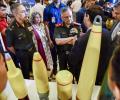
'General Subramani's appointment as military adviser in the NSCS has given him insight into decision-making at the apex level prior to formally taking over as CDS.'

It is an unusual choice to depute a retired general for the funeral of a revered religious figure but a thoughtful one in an attempt to inject verve into the bilateral relationship and restore the equilibrium in India's West Asian policies, notes Ambassador M K Bhadrakumar.

Indian stock market benchmark indices Sensex and Nifty closed nearly one per cent higher, extending their winning streak for a second day. This rally was driven by softening crude oil prices, positive geopolitical developments, and significant buying in blue-chip IT stocks, despite a broader global tech sell-off.

To get its act going in Myanmar, India would need very dynamic diplomacy and not the lazy all-eggs-in-one-basket approach, points out Subir Bhaumik.

For the foreseeable future, the most likely outcome remains continuation of the status quo. Taiwan will remain self-governing without formally declaring independence, while China continues to apply sustained pressure short of war, predict Krishnan Srinivasan and Manoj Mohanka.

Amid ongoing ceasefire negotiations, Israel is on high alert, fearing a potential surprise missile and drone attack from Iran targeting Gulf countries and Israel, according to intelligence officials.

Iran has dismissed US President Donald Trump's assertion that Iran was responsible for a drone attack on Indian ships in the Strait of Hormuz as 'simply baseless'. The Iranian embassy stated that Trump's comments were an attempt to deflect attention from recent US military strikes on merchant vessels in the Gulf of Oman, which resulted in the deaths of three Indian mariners.
Pakistani security forces have killed six terrorists in an intelligence-based operation in Balochistan province, recovering weapons and explosives. This follows another operation earlier in the week where 17 suspected terrorists were killed after a bomb attack in Quetta.

'I was fortunate enough to be associated with two of the most important battles fought by the Indian Army, the Battle of Tololing and Battle of Tiger Hill.' 'Sometimes, I think how I survived those battles on Tololing and on Tiger Hill.'

The Bombay High Court criticized the Navy for an intelligence lapse regarding a high-rise building near INS Shikra, questioning why it went unnoticed and raising concerns about selective opposition to construction projects.

Pakistan has criticised India's recent remarks on Pakistan-occupied Kashmir (PoK) protests, asserting it is addressing issues democratically. Pakistan also warned India against blocking water, calling it an "act of war," and commented on India's nuclear capabilities and its own military strikes in Afghanistan.
Security forces in Pakistan have killed 11 terrorists in the North Waziristan district of Khyber Pakhtunkhwa province during intelligence-based operations.

'A film that puts a Malayali collector, a Malayali general, and a Malayali gangster all in the same national plot does not feel pan-Indian. It feels like a school play where only one family showed up,' notes Binu Alex after watching the Mohanlal-Mammootty starrer Patriot.

Sri Lanka's response to the Easter attacks has been slow and politically contested, unlike India's swift institutional reforms after the 2008 Mumbai terror attacks, observes Colonel R Hariharan (retd).

As a ruler he was a pragmatist and adaptable, and trying all the time to strengthen and perpetuate the empire that he and his forefathers had built.He seldom, if ever, allowed his policies to be determined by his religious beliefs, notes Rudrangshu Mukherjee.

While the Andaman and Nicobar islands serve as a vital, stationary asset for projecting power in the Indian Ocean, referring to them as an unsinkable aircraft carrier ignores key military and geopolitical limitations, explains Commodore Venugopal Menon (retd).

US intelligence agencies have identified China as the primary military and cyber threat to the US, noting that it continues to enhance its capabilities to potentially take control of Taiwan, according to a report by Taipei Times.
Pakistani security forces have killed at least 17 militants in Balochistan province following a deadly train attack last week, the army said.

The autonomous, edge-native drone swarms are capable of continuing operations even when some lose connectivity, run low on battery, or return to base.

Beijing clearly intends to extend the China-Myanmar Economic Corridor to Bangladesh as part of its larger Maritime Belt and Road Initiative to boost its Indian Ocean presence.
Pakistani security forces killed 35 terrorists and captured three high-profile senior commanders during an intelligence-based operation in Balochistan's Mangla Zarghoon Ghar area.

'We caught General Pervez Musharraf talking over the phone with his Chief of General Staff Lieutenant General Mohammad Aziz. Musharraf was visiting China; Aziz was in Rawalpindi.'

India has summoned the US charge d'affaires for the second time this week to protest American Navy strikes on three commercial vessels off the coast of Oman, which resulted in the deaths of three Indian crew members. New Delhi has demanded an end to these attacks, acknowledging that the US Navy targeted the ships, some of which were reportedly non-compliant with US sanctions.
Pakistani security forces killed five terrorists in separate operations in the Khyber Pakhtunkhwa province. The operations, based on intelligence reports, took place in the Tank and Dera Ismail Khan districts, targeting members of the banned Tehrik-e-Taliban Pakistan (TTP). Weapons and ammunition were recovered from the slain terrorists.

Donald Trump has escalated rhetoric against Iran by posting AI-generated images and videos depicting US military strikes, warning Tehran that time is running out to secure a ceasefire agreement.

The IRGC is the most powerful branch of Iran's armed forces and operates independently of the country's regular military, answering directly to Supreme Leader Ali Khamenei.
Pakistani security forces killed 23 terrorists in Khyber Pakhtunkhwa province during operations on Wednesday and Thursday, according to the military's media wing.
